
Criminal Court Cases in Union County
Union County criminal court cases are split by jurisdiction. The Court of General Sessions, the criminal side of Circuit Court in the Sixteenth Judicial Circuit, handles felony and other higher-level prosecutions. The Clerk of Court keeps its docket, indictments, motions, hearing entries, dispositions, sentencing sheets, and copy files. General Sessions case numbers use the GS division marker in the Union County Public Index.
The Union County Magistrate Court issues arrest and search warrants, holds bond proceedings and preliminary hearings, and hears summary criminal and traffic matters within its statutory reach. Union and Jonesville municipal courts keep city ordinance and qualifying summary files. Those two municipal courts do not appear on the Judicial Branch's December 2025 list of municipal courts participating in Public Index. A blank Union County case search must therefore be checked with the right city court before drawing a conclusion.
Union County Criminal Court Counters
The record sought determines the correct counter. The official Union County courthouse listing places the courthouse at 322 East Main Street and gives the clerk's mailing address as P.O. Box 703. County material also routes clerk and magistrate functions through 210 West Main Street. Call the clerk at 864-429-1630 before travel because the two official address listings serve different practical routes.
The source page below shows the Judicial Branch's Union County courthouse details. It is the best place to verify current court officials and court links before seeking a criminal case file.
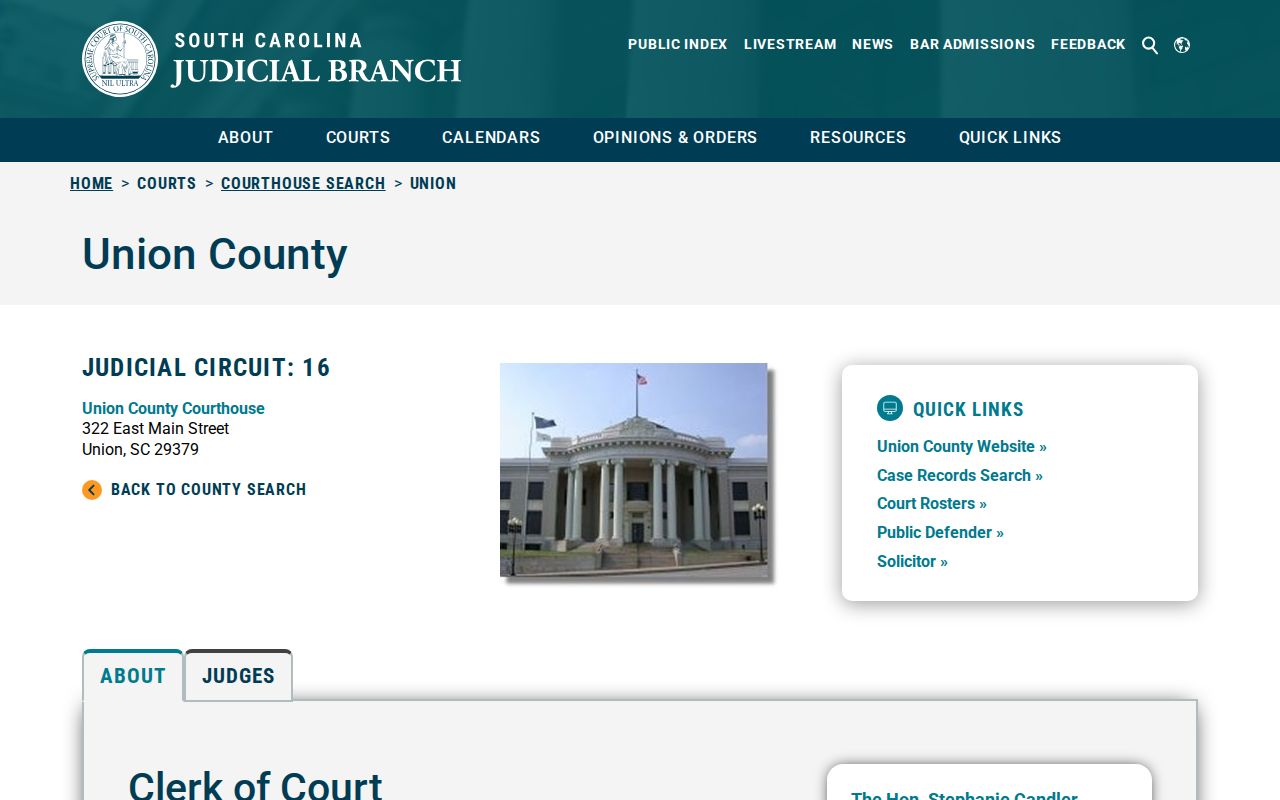
The courthouse listing points searchers toward the clerk for General Sessions documents, while the detention center remains the custodian of booking and custody facts rather than the full court record.
Clerk of Court
322 East Main Street
Mail: P.O. Box 703
Union, SC 29379-0703
864-429-1630
Magistrate Court
210 West Main Street
Union, SC 29379
864-429-1648
Fax: 864-429-1685
Union County Case Record Searches
The free Union County Public Index is the main remote route for indexed court cases. Cookies and JavaScript must be enabled, and case-detail windows may require pop-ups. Start with one or two known facts. A case number is strongest, while a full name plus a case-type filter can narrow common-name results.
- Open the Union County Public Index directly or choose Union from the Judicial Branch county gateway.
- Search by case number, or enter the last name and add the first or middle name when needed.
- Use the case-type or date filter to focus on General Sessions and the likely filing span.
- Open the linked case number. Read status, parties, charges, actions, financial entries, and any document-image icons.
- Save the exact case number, then ask the clerk for a complete, plain, or certified copy. Request a fee quote because Union County has not posted those charges.
| Field Label | Type | Required | Notes |
|---|---|---|---|
| Case Number | Text | No | Best route when the local number is known |
| Last Name | Text | Yes for name route | Use the legal name and known variants |
| First Name | Text | No | Narrows a broad last-name result |
| Middle Name | Text | No | Helpful for common names |
| Case Type | Filter | No | GS identifies General Sessions cases |
| Date Range | Date fields | No | Availability varies by search mode |
The official Public Index source shown below makes the difference between a party search and a case-number search visible.
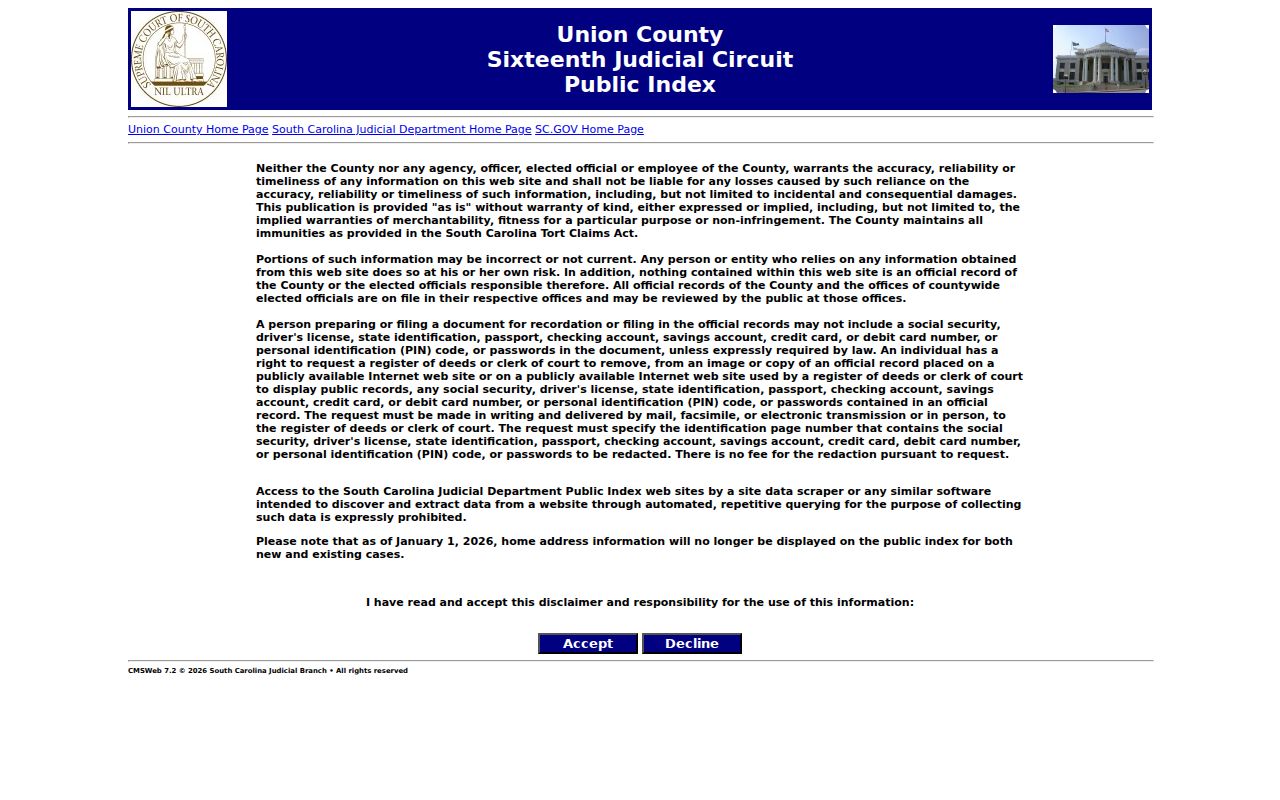
Its result is an index entry, not a guarantee that every pleading or signed order can be downloaded without contacting the Union County clerk.
Union Municipal Cases Need a Call
A common search error is treating the county index as a full list of every criminal file. Union Municipal Court and Jonesville Municipal Court are absent from the current participating-municipal-court list. City ordinance and summary cases may therefore exist even when no matching county index entry appears. Call Union Municipal Court at 864-429-1713 or Jonesville Municipal Court at 864-674-5746, based on where the charge arose.
Magistrate records can also sit apart from a later General Sessions file. Ask which court issued the warrant, set bond, or heard the summary charge. If a felony-level prosecution moved upward, use the clerk's General Sessions case number to trace the indictment and outcome. Court rosters help identify a scheduled appearance, but a roster is not a judgment and cannot prove how the case ended.
Note: A failed online search does not clear a person of a Union County municipal or lower-court case.
What a Criminal Case File Contains
A Union County criminal case file records what prosecutors filed and what the court did. It differs from the officer's incident narrative and the detention center's intake entry. The case file can show that an arrest charge changed, that a grand jury returned an indictment, or that one count ended while a companion count continued. Read each charge line and outcome rather than relying on the first allegation.
| Case Number & Court | Identifies Union County, the division, filing year, sequence, and court responsible for the file. |
|---|---|
| Charging Document | May include a complaint, warrant, or General Sessions indictment setting out the filed accusation. |
| Docket Entries | Lists filings, bond events, attorney appearances, motions, hearings, bench warrants, and other court actions. |
| Parties & Counsel | Names the State, defendant, and attorneys when those roles have been entered. |
| Disposition | Shows the outcome by charge, such as conviction, acquittal, dismissal, or nolle prosequi, with dates when reported. |
| Sentence | Records the punishment and court-ordered terms after a conviction. |
A document icon can lead to an image, but images are not guaranteed for every Union County case. Request the signed order or sentencing sheet from the clerk when the exact text matters.
Union County Docket Terms Explained
Several short entries carry a large legal effect. Reading them in plain terms helps separate an accusation from a final result. The court docket and the signed document should agree, but the signed order is the stronger source when a summary entry is unclear.
- True bill
- The grand jury returned an indictment. It is an accusation, not a conviction.
- Nolle prosequi
- The prosecutor formally chose not to continue that charge at the time shown.
- Disposition
- The recorded outcome of a charge or case.
- Bench warrant
- A judge-issued warrant, often tied to a missed appearance or alleged violation.
- Recognizance
- Release based on a promise and conditions rather than deposited cash.
Criminal Case Stages in Union County
A Union County General Sessions matter can begin with an arrest or complaint, followed by a bond proceeding in summary court and a preliminary hearing when requested and available. The Sixteenth Circuit Solicitor reviews the case. A grand jury may return an indictment, after which the case proceeds through arraignment, motions, plea talks, or trial. A plea or verdict leads to disposition and, after conviction, sentencing. Appellate review may follow.
Case flow: Charges Filed › Arraignment › Pretrial › Plea or Trial › Disposition › Sentencing
The officer's first charge can change before indictment. The Union County arrest search is useful for the booking event, while the court file is the better source for the filed charge and final result.
Sixteenth Circuit Case Routing
The Sixteenth Judicial Circuit Solicitor's Office serves Union and York Counties. It prosecutes General Sessions matters and operates routes that include Pre-Trial Intervention, Juvenile Arbitration, Traffic Education, and Worthless Check work. A prosecutor's file is not the public court file, yet solicitor choices help explain why the arrest allegation, indictment, and final disposition may differ.
The official solicitor source below identifies the circuit office serving Union County criminal court cases.
For public docket entries and certified court documents, return to the clerk. For representation, the Union County Public Defender serves eligible appointed clients but is not a public-record archive.
Access Rules for Case Records
South Carolina court records are generally open, but public access has limits. Sealed and expunged cases do not appear in the public index. Juvenile matters are restricted. Rule 41.2 protects Social Security numbers, financial identifiers, driver and passport numbers, passwords, PINs, and minor-victim names. Since January 1, 2026, home addresses are no longer displayed for new or existing Public Index cases.
The South Carolina Freedom of Information Act governs many agency records, yet a judicial case file is best requested from the clerk that keeps it. Remote access can be narrower than inspection at the courthouse. If an entry appears incomplete, provide the case number and document name to the clerk, ask whether the item exists off-line, and request the available copy type.
Public display also differs from the records available to parties or justice agencies. A redacted Union County index view does not prove that protected data never entered the case file. The clerk can explain which public version may be inspected, but cannot release sealed material or give legal advice about access.
Access point: A missing image or delayed index entry does not mean a Union County court document does not exist. Confirm it with the custodian.
When Union County Index Data Lags
Clerk entry and agency reporting can take time. First save the case number and compare the status, action history, and disposition date. Then call the clerk at 864-429-1630 and name the exact item sought, such as an indictment, plea sheet, sentencing sheet, or dismissal order. Ask for the current copy charge and delivery options because no stable Union County fee schedule was found.
A blank disposition can also reflect a reporting or matching gap rather than an active case. The signed Union County court order is the best way to resolve that question. If a statewide SLED CATCH report lacks the result, obtain the court disposition first and use SLED's correction channel. That careful sequence keeps a repository lag from being mistaken for the true status of the court case.